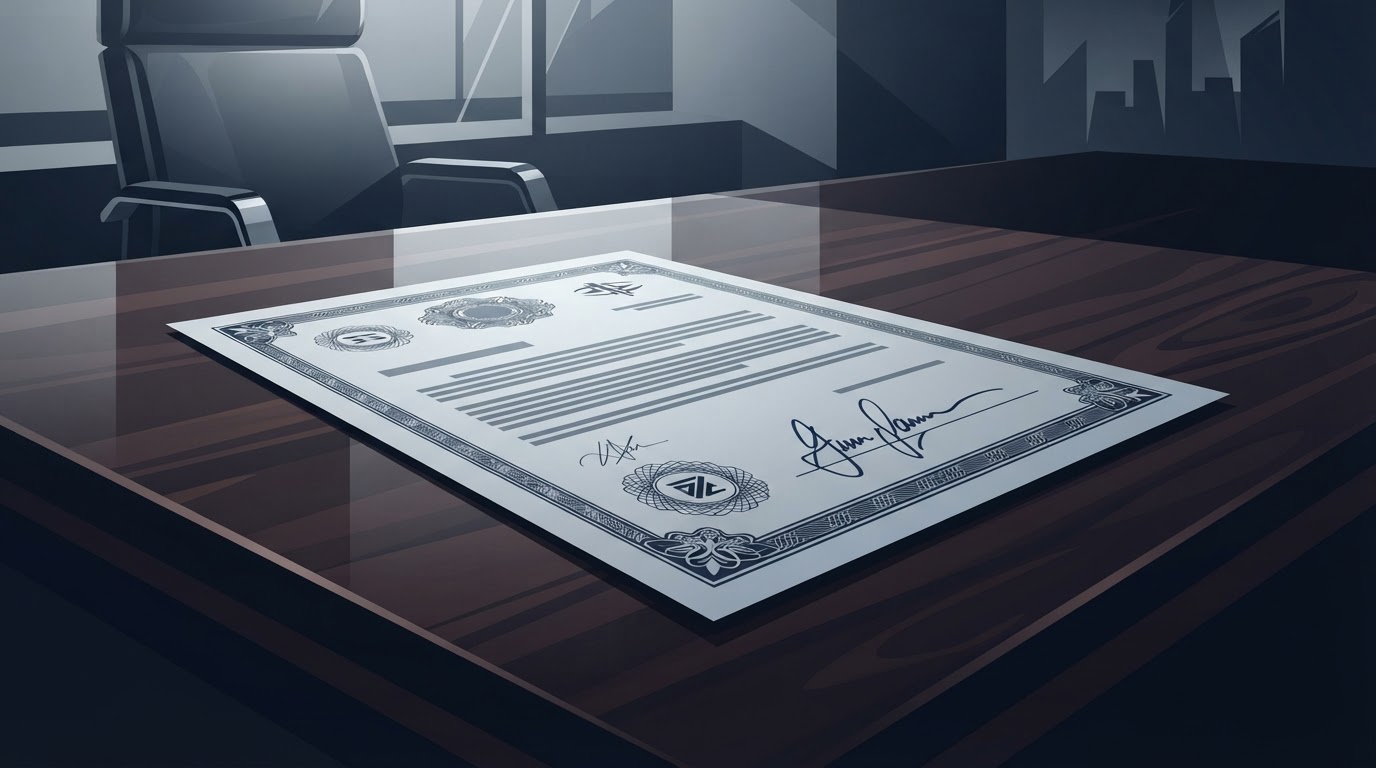
President Donald Trump signed the Accord on Super Intelligence alongside executives from six top artificial intelligence firms, but a proofreading error on the official document quickly drew widespread public attention. The signature page listed Trump as the "President of the Unites States" rather than "United States."
White House Accord Details and Tech Signatories
The voluntary agreement aims to govern advanced artificial intelligence development through self-policing standards rather than rigid legislation. Alongside Trump, the signatories included NVIDIA CEO Jensen Huang, Google's Sundar Pichai, Anthropic's Dario Amodei, Meta's Mark Zuckerberg, OpenAI's Greg Brockman, and xAI's Elon Musk, expanding on Trump's voluntary AI safety accord with six tech leaders.
Under the terms of the agreement, participating companies commit to monitoring system risks, undergoing external evaluation, and maintaining board-level oversight over powerful AI systems. Huang outlined four key pillars for compliance: internal monitoring, dedicated oversight teams, external assessments, and board committees. Trump characterized the deal as "morally binding" while reiterating his preference for industry-led guidelines over formal government regulations to accelerate data center expansion.
Proofreading Error Overshadows Policy Event
Despite the high-profile industry gathering on September 30, 2026, social media users quickly focused on the typographical mistake beneath Trump's signature. Representative Melanie Stansbury highlighted the misspelling on X, noting the document referenced the "Unites States." Photos of the signed accord had already been published online by both the White House and Huang before the oversight was identified by observers.
- Six AI leaders signed the voluntary framework, including Elon Musk, Mark Zuckerberg, and Jensen Huang.
- The agreement establishes four layers of self-policing for frontier model safety and oversight.
- The official signature document contained a typo reading "President of the Unites States."
Why It Matters
While the typographical slip dominated headlines, the accord reflects the White House's strategy to rely on voluntary commitments from major tech firms rather than mandatory federal regulations. As market interest surrounding AI infrastructure grows, industry-driven governance allows companies to expand computing power without immediate statutory hurdles. However, the lack of enforceable penalties leaves open questions about how strictly these voluntary frameworks will be upheld across competing firms.