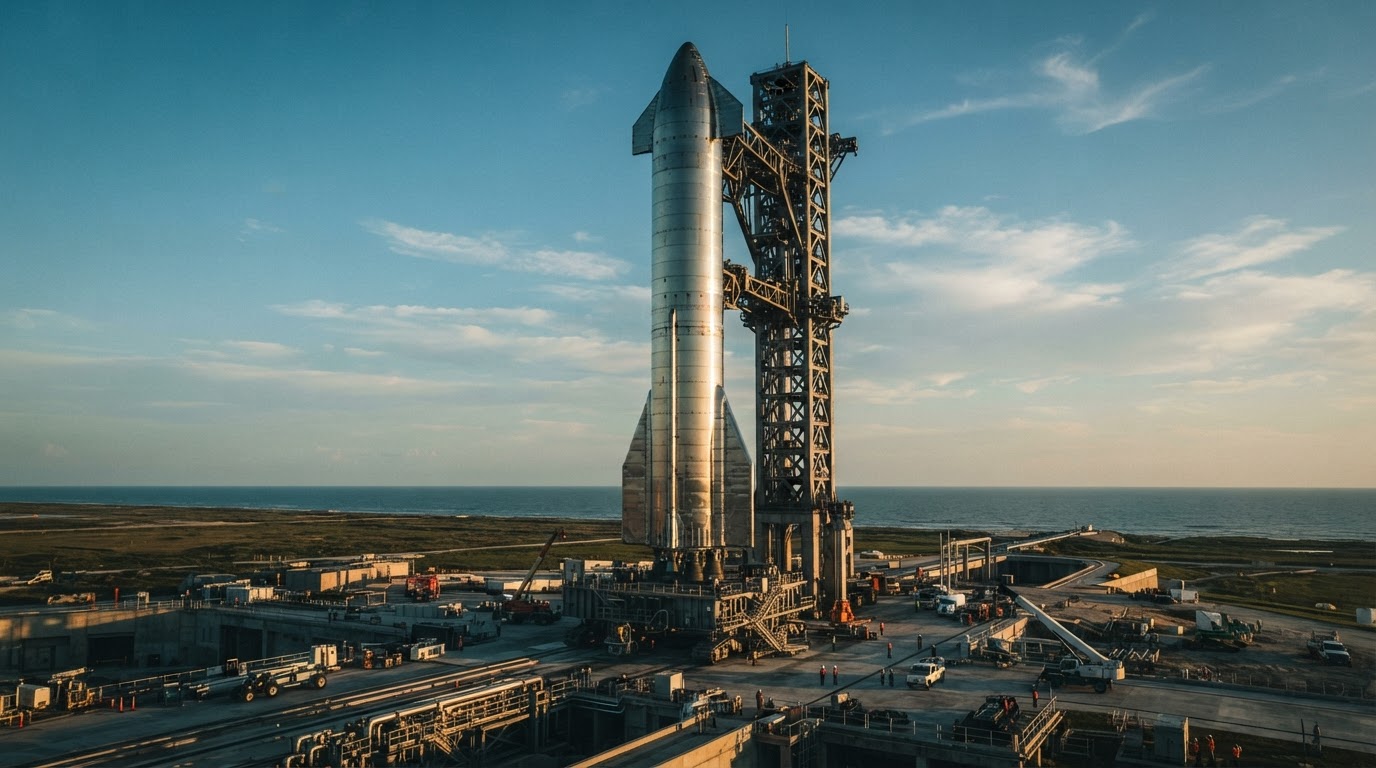
Elon Musk’s SpaceX has carried approximately 1,950 tonnes into orbit so far in 2026, capturing roughly 80% of the global total mass sent into space. Data from launch tracking platform ooinsights shows that despite 236 successful launches worldwide delivering 2,396 tonnes to orbit—a 4.7% decline compared to the same point in 2025—SpaceX remains far ahead of international and commercial competitors.
Starship Propels Mass-to-Orbit Dominance
According to ooinsights, the combined total lifted by the next seven launch providers accounts for less than a quarter of SpaceX’s total volume. Only China’s state-owned China Aerospace Science and Technology Corporation (CASC) has maintained a launch frequency that keeps pace, though tracking by mass delivered widens SpaceX's lead dramatically.
Much of this payload margin stems from the company's heavy-lift rocket, Starship, which logged 120 tonnes across each of its three flights this year. Responding on October 18, 2026, to the payload distribution chart on social platform X, Elon Musk described SpaceX as "an anomaly in the matrix," referencing the iconic sci-fi film franchise. This milestone arrives as major technology and aerospace players face rigorous public scrutiny, mirroring broader sector trends where tech and aerospace giants face earnings tests over capital spending.
Key Takeaways
- SpaceX delivered 1,950 tonnes—about 80%—of the 2,396 tonnes launched globally in 2026.
- Starship contributed significantly, moving 120 tonnes per launch across three flights.
- Overall global mass delivered is down 4.7% from 2025 across 236 successful launches.
- Elon Musk listed space mass delivery alongside Optimus and Cybercab as primary scaling factors for future economic growth.
Scaling Beyond Earth: Optimus, Cybercab, and K2 Economy
Addressing comments from a Tesla investor who urged critics to consider a merger between Tesla and SpaceX, Musk rejected the idea and emphasized that Tesla's future financial worth will rely on autonomous tech rather than legacy vehicle sales. Musk stated that Optimus, Tesla's humanoid robot, and Cybercab, its driverless taxi, will comprise "the vast majority of Tesla’s value." The comments come amidst an accelerating global robotics race, such as when China unveiled industrial robotics to rival Musk’s Optimus, as well as ongoing discussions following the Tesla Flying Roadster demonstration.
Musk outlined four specific domains capable of scaling economically to "K2 and beyond"—referencing a Type II civilization on the Kardashev scale that captures the full energy output of its star:
- Superintelligence
- Robots
- Solar power
- Mass to space
Among these four frontiers, SpaceX's mass to orbit stands out as the only sector currently operating at massive commercial scale. With Musk forecasting an eventual $100 trillion valuation for SpaceX, launch payload capacity has become a critical benchmark for investors.
Why It Matters
SpaceX’s structural dominance over orbital logistics highlights how payload mass—rather than raw launch frequency—has become the defining metric of space infrastructure. By establishing a near-monopoly on orbital transport through Starship, SpaceX provides the core physical capacity required for next-generation satellite constellations and deep-space missions. For markets evaluating Musk's broader technology ecosystem, mass-to-orbit throughput provides the operational backbone underpinning his long-term vision for artificial intelligence, robotics, and off-world expansion.