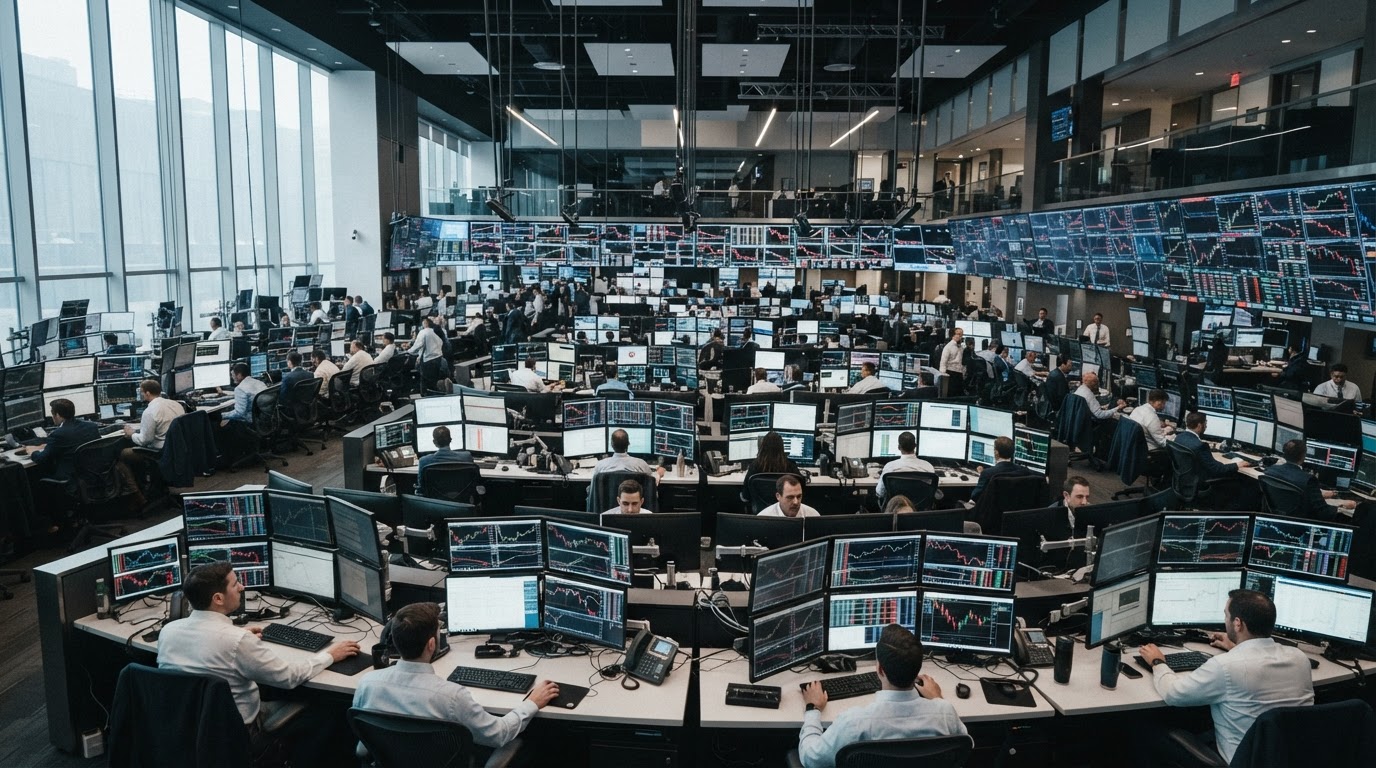
More than half of all tokenized U.S. stock trading occurs outside regular Wall Street hours, according to the International Monetary Fund’s (IMF) October Global Financial Stability Report.
The study reveals that round-the-clock trading, fractional shares, and international access are driving demand for tokenized equities, even as the asset class experiences significantly higher volatility than conventional U.S. stock markets.
Price Discovery Outside Regular Trading Hours
The IMF evaluated five active tokenized equity products issued by Ondo and xStocks, providing exposure to the S&P 500, Nasdaq, Tesla, Alphabet, and Nvidia. Researchers analyzed data across 11 centralized and decentralized exchanges, collecting over 2 million five-minute price and volume observations spanning 365 trading days. The sampled assets represented $345 million in market capitalization, or roughly 15% of the $2.3 billion total tokenized equity market as of July 31.
The report found that more than 50% of overall trading volume took place outside traditional U.S. market hours, which run from 9:30 a.m. to 4:00 p.m. Eastern. Additionally, approximately 80% of all tokenized equity transactions involved fractions smaller than one share.
Crucially, overnight tokenized stock prices contained early price signals for standard equities. The IMF estimated that the overnight price pass-through ranged between 87% and 99% when compared to the performance of underlying stocks during the initial five minutes of regular trading. This indicates strong information alignment, even while traditional stock exchanges remain closed and analysts evaluate broad market shifts like Wall Street Q3 earnings expectations.
Higher Volatility and Liquidity Risks
Despite active off-hours price discovery, tokenized stock trading exhibits structural vulnerabilities. The study found that realized volatility in tokenized equities was approximately 1.5 times (50% higher) that of their traditional stock counterparts, with price swings expanding further on decentralized exchanges due to thin market depth.
The IMF estimated that public tokenized real-world assets (excluding repurchase agreements and stablecoins) reached $65 billion by July, a tiny fraction of the $300 trillion traditional capital market. While systemic financial risks remain limited at current adoption levels, the fund warned that automated 24/7 liquidations could amplify selling pressure during low-liquidity periods outside conventional session hours—a concern echoed in other cross-border crypto assessments like FSB warnings on financial stability risks.
Key Takeaways
- After-Hours Dominance: Over 50% of tokenized U.S. stock trading occurs outside regular 9:30 a.m. to 4:00 p.m. Eastern hours.
- Retail Demand: Approximately 80% of transactions involve less than one share.
- Price Pass-Through: Overnight tokenized prices reflect 87% to 99% of price adjustments seen in the first five minutes of the next traditional trading session.
- Higher Volatility: Tokenized equities experience 50% higher realized volatility than underlying shares.
- Market Size: Tokenized real-world assets reached $65 billion in July, compared to $300 trillion in conventional capital markets.
Why It Matters
The IMF findings prove that tokenized stock products are actively serving as an overnight price discovery mechanism for global investors who lack 24/7 access to U.S. exchanges. However, with 50% higher volatility and fragmented liquidity, off-hours continuous trading poses risks of automated flash liquidations when traditional liquidity buffers are offline. As traditional financial institutions expand tokenized equity offerings, regulatory frameworks will need to introduce continuous circuit breakers to prevent overnight crypto market stress from destabilizing mainstream financial assets.