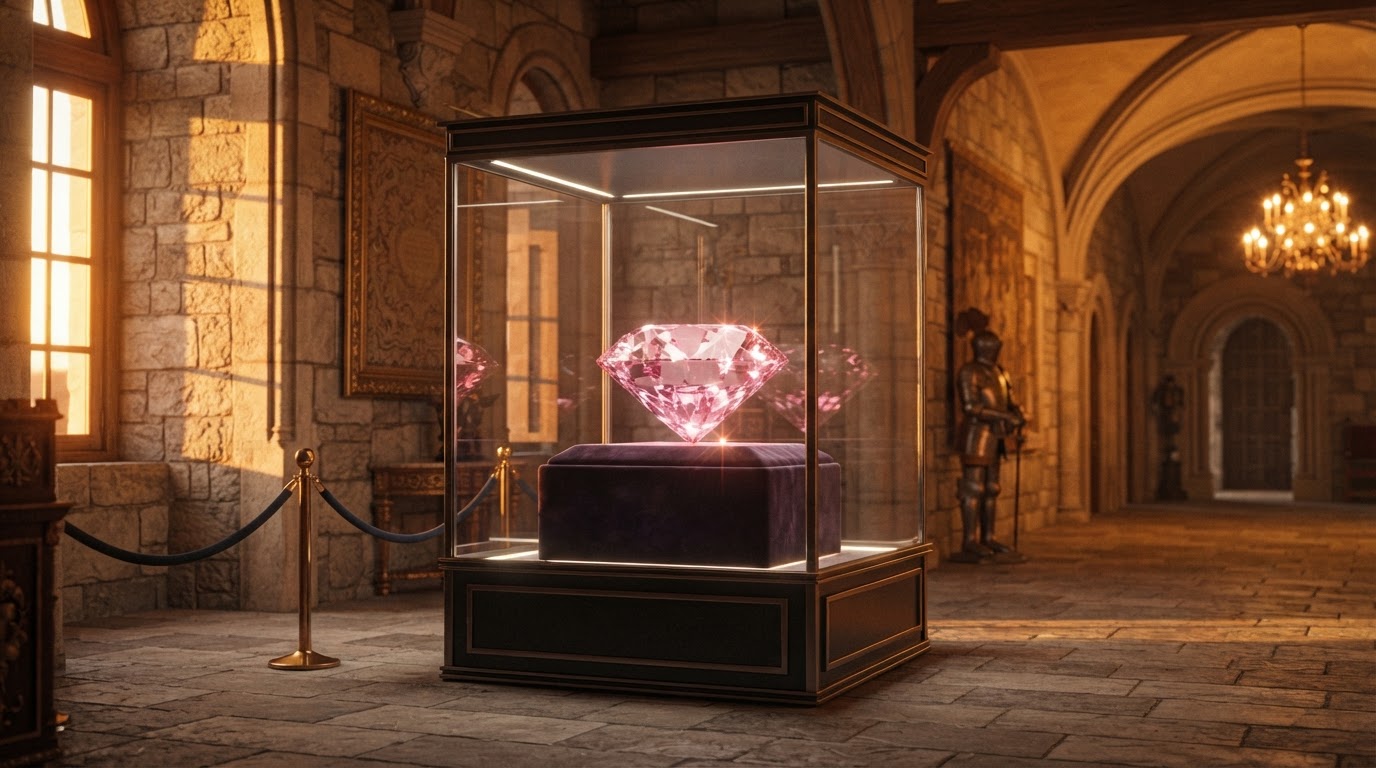
The nine-carat Grand Condé pink diamond returned to public display at the Château de Chantilly on October 17, a century after its famous 1926 theft, even as traditional diamond market benchmarks fall to historic lows. The gem's reappearance comes at a time when average natural stone prices have crashed 51% since 2021.
- The 9-carat Grand Condé pink diamond was re-exposed to public view in France following a 100-year replacement by a replica.
- Commercial 1-carat natural diamond prices dropped to $3,898, down from $8,007 in 2021.
- The Diamond Standard Index touched a record low of 2,490 points in early August.
- Lab-grown alternatives comprised 61% of engagement rings sold in 2025 while selling at discounts up to 90%.
The Legend and Rarity of the Grand Condé
Stolen in October 1926 by two amateur thieves, the stone was hidden inside a hollowed-out apple in a hotel room until a hungry maid bit into it roughly two months later. Held in the Condé collection since 1740, the diamond survived the French Revolution. According to Sotheby's, fewer than 0.15% of diamonds graded by the Gemological Institute of America (GIA) are predominantly pink, a coloration caused by extreme underground pressure altering its crystal structure.
Market Collapse Driven by Lab-Grown Supply
While historic stones retain distinct value, standard mined diamonds are experiencing severe price drops. The IDEX Diamond Index has lost nearly half its value since early 2022. Excess inventory continues to weigh on the market despite output cuts by major mining firms. Meanwhile, synthetic diamonds—which are chemically identical—cost up to 90% less and captured 61% of the engagement ring market in 2025.
Traditional commodities face shifting macroeconomic environments, such as recent price movements where gold prices dropped to $4,145 alongside Bank of America forecasts placing gold below $4,000 toward year-end.
Why It Matters
The collapse in natural diamond prices illustrates a fundamental shift in commodity valuation driven by modern technological substitution. As lab-grown production scales up to displace retail demand, unbranded natural diamonds are losing their historical store-of-value premium. Moving forward, luxury asset values will likely depend almost entirely on proven historical provenance and verifiable geological scarcity rather than simple physical composition.