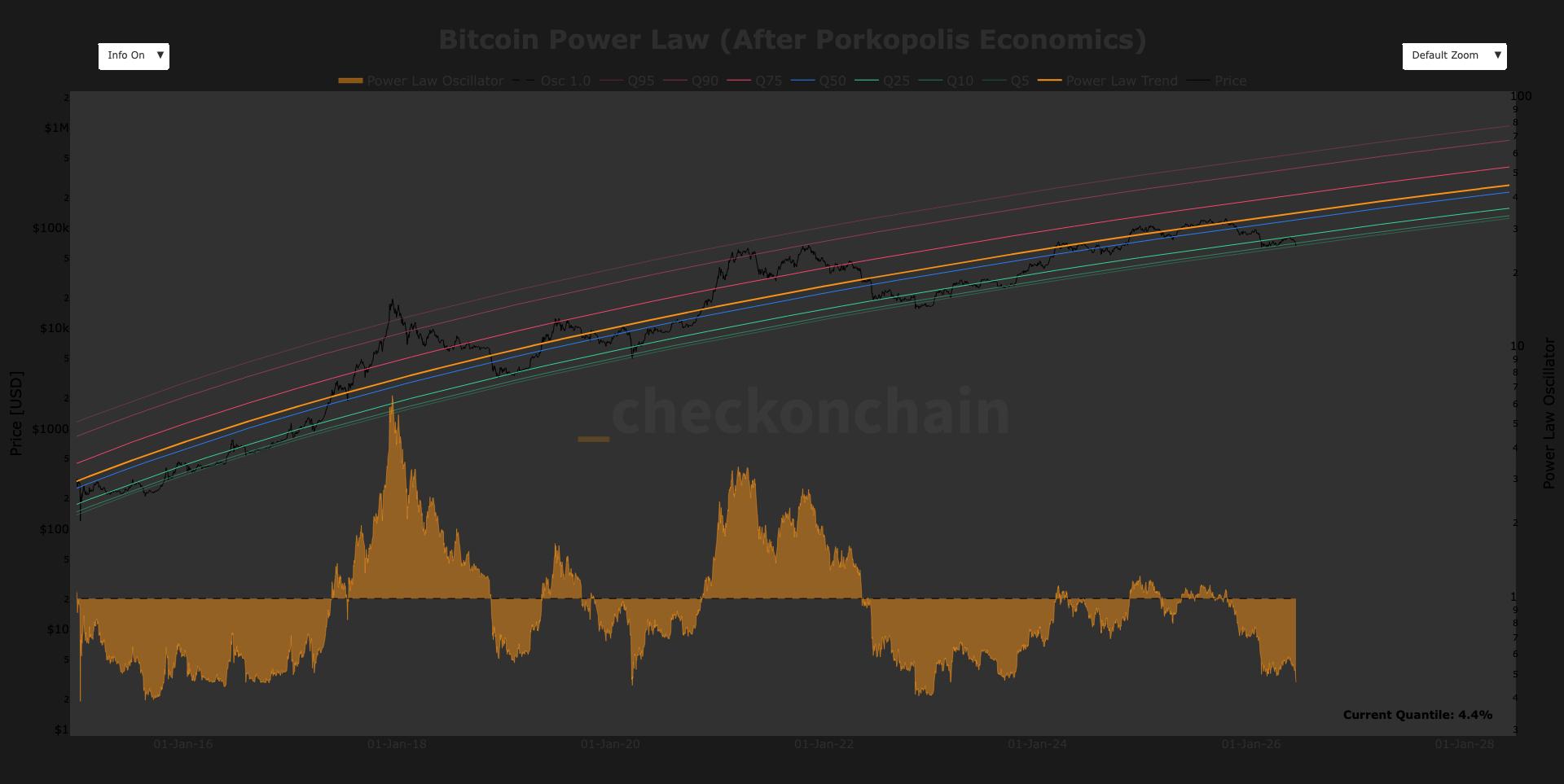
Bitcoin's current market position, when analyzed through a long-term valuation framework known as the power law model, suggests the cryptocurrency is trading at a significant discount. This particular level of undervaluation has historically appeared just before notable price rebounds for the digital asset.
Unpacking the Power Law Model
The power law model is a sophisticated analytical tool often employed to understand Bitcoin's long-term price trajectory. It plots Bitcoin's price against time on a logarithmic scale, revealing a consistent, long-term growth curve despite its characteristic volatility. Essentially, the model suggests that while Bitcoin's price may fluctuate wildly in the short term, its overall growth tends to follow a predictable pattern of diminishing returns over extended periods. Deviations below this trend line indicate periods of undervaluation, while deviations above suggest overvaluation.
Currently, Bitcoin is sitting at one of its deepest points below this established trend line. This isn't an unprecedented event; the model identified similar profound discounts during two highly impactful periods in recent crypto history. The first was during the March 2020 market crash, triggered by global economic uncertainty, which saw Bitcoin’s price plummet dramatically. The second was in the wake of the FTX exchange collapse in late 2022, an event that sent shockwaves through the entire cryptocurrency ecosystem and led to widespread market apprehension.
Historic Precedents and Future Outlook
What makes the current position particularly noteworthy is the historical context. Following the March 2020 crash, Bitcoin embarked on one of its most significant bull runs, ultimately reaching new all-time highs. Similarly, the period after the FTX collapse marked the beginning of a recovery phase, which eventually led to the market resurgence witnessed in 2023 and early 2024. These past instances highlight that while such deep discounts can be unsettling for investors, they have often served as strong indicators of an impending market turnaround.
The power law model provides a long-term perspective, suggesting that the current price point represents a substantial opportunity for those looking at Bitcoin's multi-year potential rather than short-term fluctuations. While other factors like macroeconomic conditions and regulatory developments can always influence market movements, the model points to an underlying undervaluation. Recent market dynamics, including Bitcoin's dip below $66,000 amidst geopolitical tensions and stagnation concerns raised by institutions like Citi, contribute to the asset trading at these discounted levels.
Key Takeaways
- Bitcoin is currently trading at a significant discount according to the power law model.
- This level of undervaluation has historically preceded major price rebounds.
- Comparable historical instances include the March 2020 crash and the FTX collapse.
- The model suggests Bitcoin is positioned for a potential long-term recovery or upward trend.
- It offers a long-term perspective, distinguishing from short-term market noise.
It's crucial for investors to remember that no model guarantees future performance, and the crypto market remains inherently volatile. However, the power law model's track record provides a compelling argument for Bitcoin's current position as a potentially undervalued asset, signaling a point where historical patterns suggest a rebound could be on the horizon. This long-term view can help temper reactions to short-term price movements and focus on the broader trajectory of the digital currency.